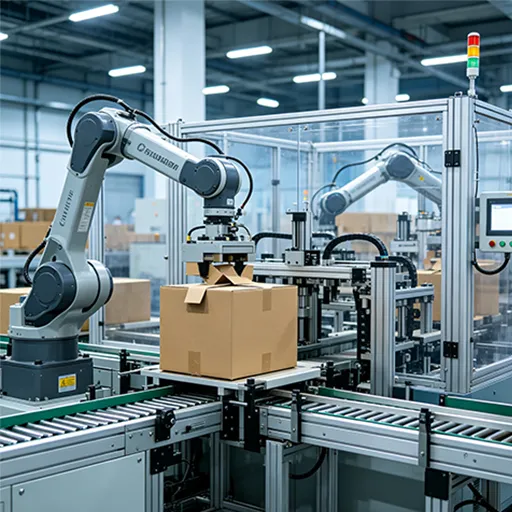
Core Advantages of Automatic Case Packers From the Manufacturer
According to professional case-packer manufacturers, the main strengths of this end-of-line machine are reflected in five key areas.
1. Reasonable Structure and Reliable Work Performance
The automatic case packer integrates machinery, pneumatic components and electronic controls into one compact unit with a simplified overall structure. Its pneumatic bottle-gripping mechanism, combined with proven mechanical motion, sensitive pneumatic devices and advanced electronic control technology, can place bottles into cartons accurately and dependably.
2. Smooth and Stable Machine Movements
The main drive system is powered by a dual-speed motor equipped with a brake. Micro-computer logic smoothly controls start-up, acceleration, deceleration and braking cycles. A unique four-link mechanism guarantees steady travelling, transferring and landing of bottles through the whole speed-changing sequence.
3. High Production Output Efficiency
The equipment runs slowly and steadily at start-up and termination, runs fast during the working stroke, and returns rapidly. This design cuts down non-working idle time and improves overall line throughput.
4. Simple-to-Use Automated Operation
The machine works fully automatically. It can adjust production speed autonomously and keep perfect synchronization with upstream packaging production lines.
5. Enhanced Operational Safety
Beyond physical protective housings and safety guards, photoelectric safety sensors are fitted. The unit will stop automatically if an operator accidentally enters the hazardous working zone. The machine runs at low noise level and adopts oil-free lubrication pneumatic parts to prevent oil contamination, fully meeting hygiene-related production standards.
Standard Operating Procedures for Automatic Case Packers
Step 1. Air-pressure check before startup
Open the main air valve switch. Confirm system air pressure stays within 0.6-0.8 MPa, while bottle-related circuit pressure is kept around 0.2 MPa.
Step 2. Power-on self-check and reset
Switch on the main power supply. Let the system run self-diagnostics, check for inverter alarm messages, then hit the reset button on the operator console.
Step 3. Parameter configuration and mode selection
Open the parameter screen and select the corresponding bottle type. Switch into manual mode and test the gripper air-release function. Navigate to the automatic page and set bottle-feeding mode to multi-channel counting. Execute output reset to make sure current-shift output reads zero.
Step 4. Complete manual debugging for all motions
Test every movement manually and verify flexibility and suitable running speed: bottle-pressing, front-box inspection, rear-box inspection, high-low guide frames, opening-closing of high-low gripper heads, bottle-separation logic, gripper inflation/deflation control, rocker-arm up-and-down travel and inching carton-motor bottle feeding. Confirm all movements respond correctly with good lubrication status.
Step 5. Run no-load simulation operation
Start simulation without real bottles. On the manual screen, switch bottle-separation from prohibited to permitted status. Cover the three inspection sensors with objects so all indicator lights activate. Move to the automatic page, enable simulation run and activate automatic mode. Press the start button on the panel to begin the empty-machine simulation cycle.
Step 6. Launch formal production run
Return to manual page; activate high-position bottle-pressing and disable sorting function. Feed bottles slowly until the supply area is full; upright any fallen bottles promptly. Enable low-position bottle-pressing and turn bottle-separation permission on. Return to manual screen, trigger full-bottle signal and jog bottle-separation. Review values on the parameter page. Following this full operating workflow helps you achieve safe production targets while maximizing the automatic working efficiency of your case packer.